

Nightfall AI
Modern DLP for modern work
Who is This For
SMB compliance owners and security leads under pressure to reduce data exposure and demonstrate control to auditors.
Teams running Microsoft 365 or Google Workspace, often with Slack/Teams, Atlassian, Salesforce, Notion, or Zendesk in the mix.
Organizations adopting AI tools and wanting sensible guardrails without heavy friction.
Business owners in regulated and data-sensitive industries such as financial services, healthcare, technology/SaaS, fintech, legal, and manufacturing.
What Nightfall delivers (at a glance)
Reduce meaningful data exposure:
AI-native detection identifies PHI/PII/PCI, secrets/keys, and sensitive IP and reduces noisy false positives so you can focus on the real risks.
Remediation where work happens
guide users, block, redact, quarantine or encrypt to help issues get resolved without long playbooks.
Coverage that matches modern work:
SaaS apps, email, browsers/endpoints, plus visibility into risky sharing and posture drift.
Audit-supporting evidence:
clear events, actions, and history to back up your policies, including exportable dashboard reporting and optional Nyx-assisted summaries.
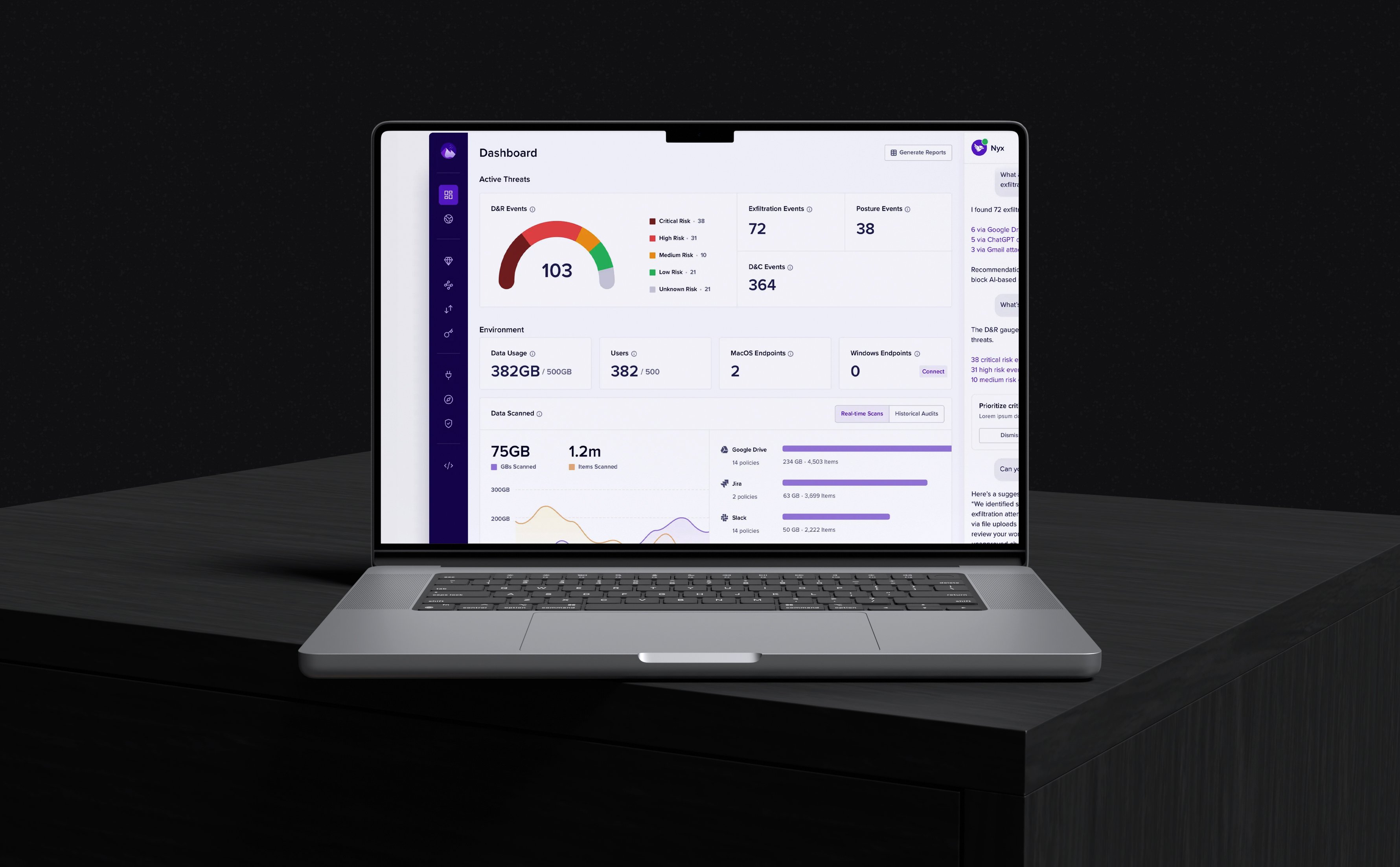
How Nightfall protects (the four pillars)
Data Detection & Response (DDR):
find and fix PHI, PII, PCI, source code, secrets, and custom-defined data (including entity/prompt-based detectors) in the tools your people use.
Data Exfiltration Prevention (DEX):
trace movement of sensitive data and take policy-driven action before it leaves your environment. Help stop data exfiltration and help prevent data leakage to Shadow AI using a lightweight agent (Mac/Windows), browser plugin, and SaaS sensors.
Data Discovery & Classification (DDC):
eliminate sensitive data exposure and revoke inappropriate data sharing for data at rest via API-based at-rest scanning across supported SaaS apps.
SaaS Security Posture Management (SSPM):
watch sharing/permissions drift and surface misconfiguration risk across apps.
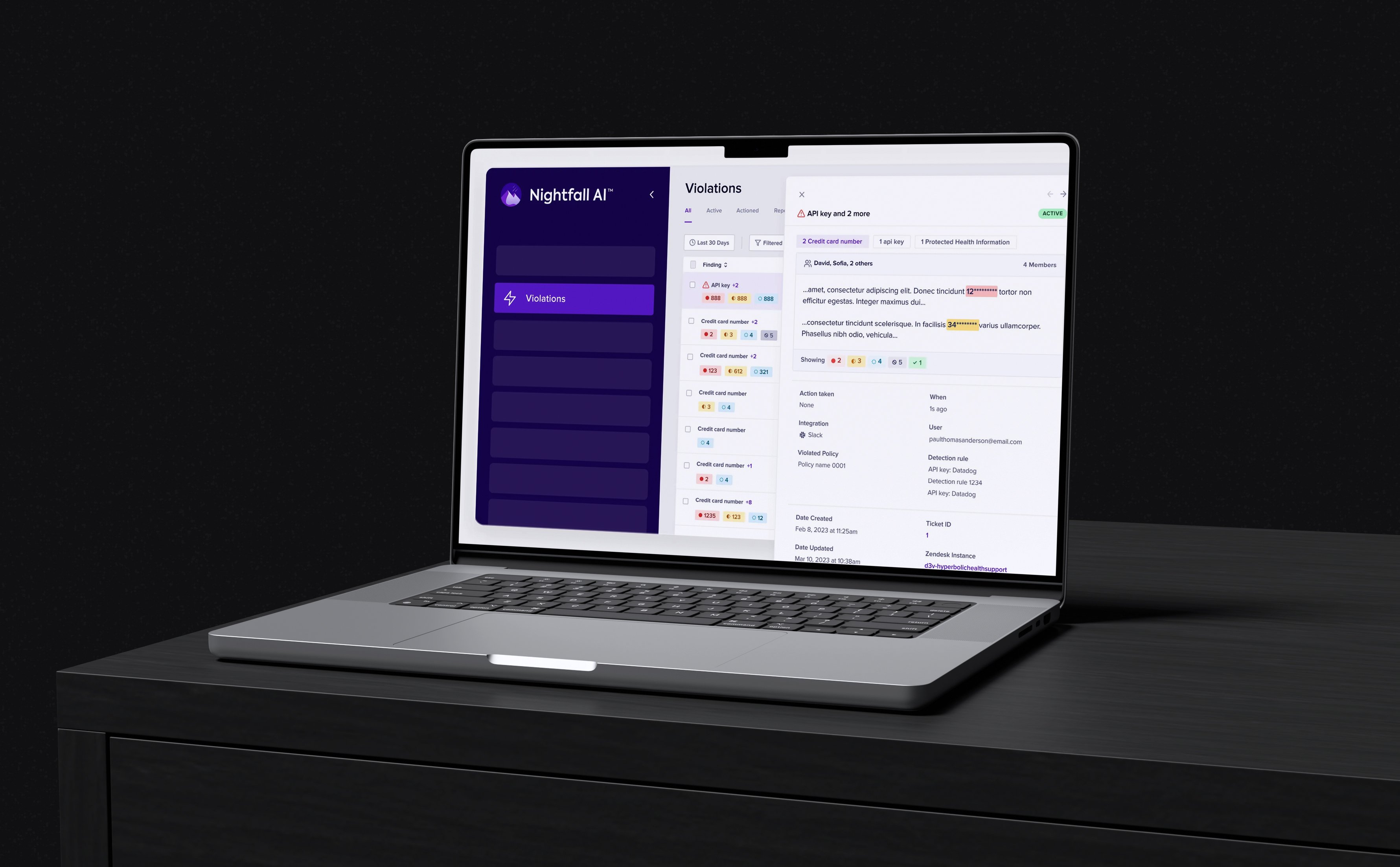
Where Nightfall works
Nightfall integrates with major SaaS and email platforms used by SMBs. It can also run historical scans in supported apps to uncover exposure created before deployment.
- Slack
- Google Drive & Gmail
- Microsoft Teams, OneDrive & SharePoint Online
- Notion
- Zendesk
- Browsers & managed endpoints
- AI applications (high-level monitoring/coaching; see note below)
- Microsoft Exchange Online (Outlook)
- Jira & Confluence
- Salesforce
Detection & policy:
AI-native detection identifies PHI/PII/PCI, secrets/keys, and sensitive IP and reduces noisy false positives so you can focus on the real risks.
Prebuilt detectors for common sensitive data:
PHI, PII, PCI, secrets/credentials, financial identifiers, and more.
Custom detectors you can tailor:
dictionary lists, file-type rules, file fingerprinting, regex patterns, and entity/prompt-based logic.
Policy per integration:
each app/email surface can have its own actions and exceptions so policies fit how teams actually work.
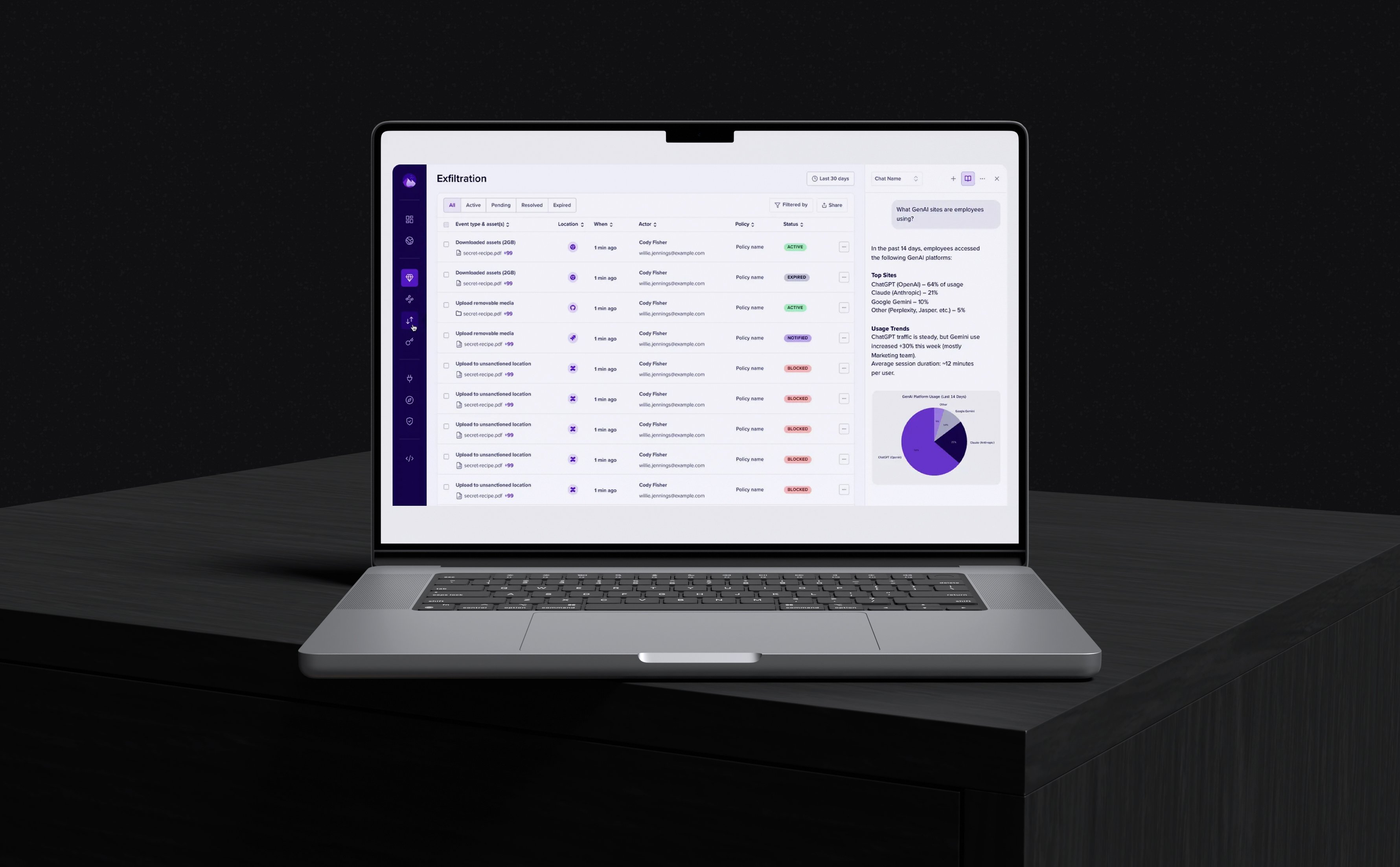
Email data protection and encryption
(Gmail & Exchange Online)
When sensitive content is detected in email, Nightfall policies can encrypt messages and attachments and apply controls that help protect recipients and your organization:
Admin alerting and workflow routing can be configured so your team stays informed without drowning in noise.
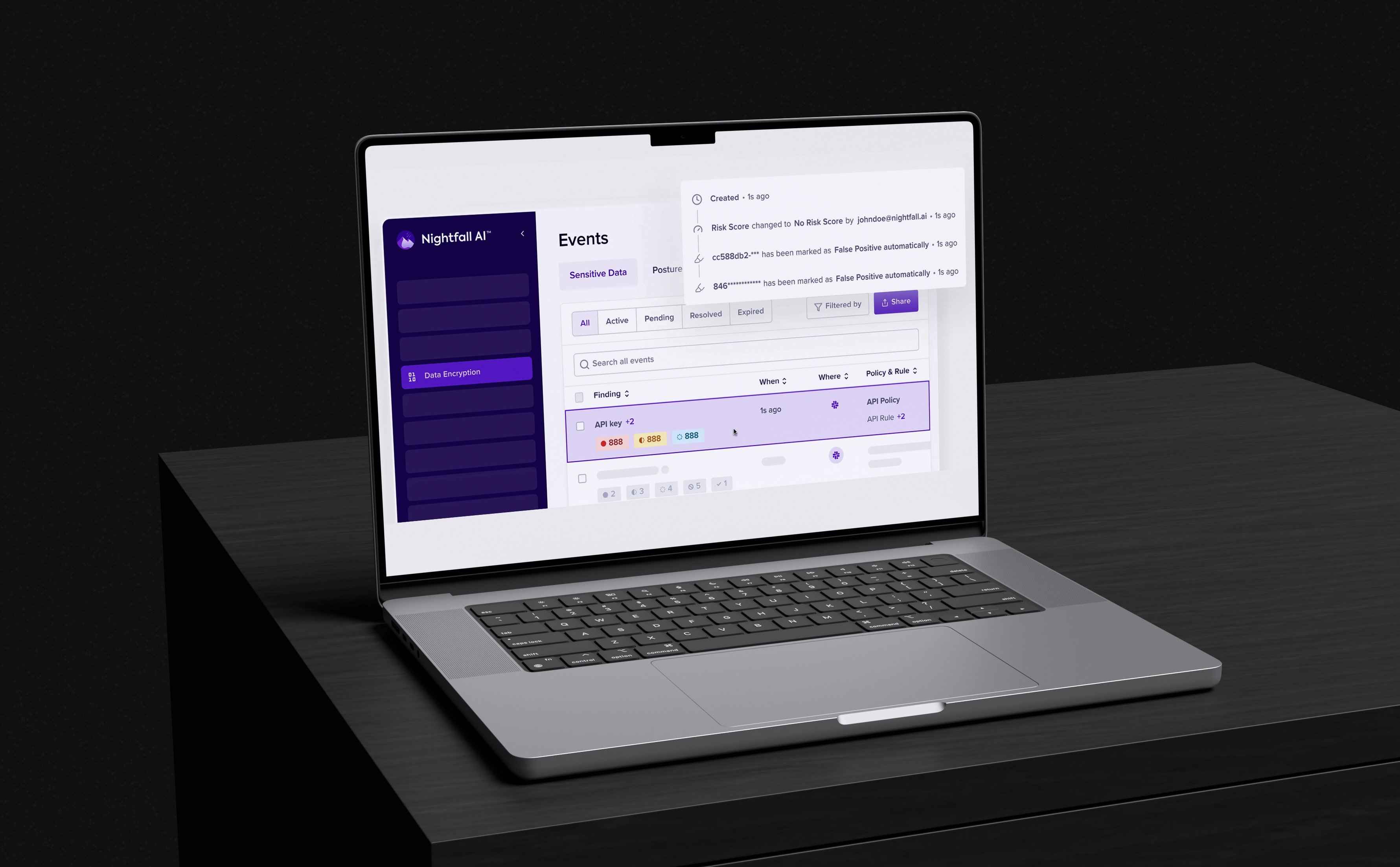
About AI Assistants and Copilots
Nightfall can help monitor and coach risky behavior around prompts and AI usage at a high level. Because enforcement patterns differ by tool and are still evolving, we avoid promising file-upload blocking until a dependable policy is confirmed in your environment.
Time to Value
Connect core apps and email quickly; start in monitor mode to see real exposure fast.
Tune policies with real findings; enable targeted actions (redact/quarantine/encrypt) when confidence is high.
Use regular reviews to show posture improvement and support audit discussions.
How Nightfall compares
These are the most common head-to-heads we’re asked about, summarized for SMB teams.
Nightfall vs. Google Cloud DLP
Breadth beyond Google: Nightfall emphasizes consistent policies and actions across non-Google apps and email.
Operations & response: in-app coaching and automated actions to reduce manual triage.
Integrations & APIs: flexible alerting and webhook options to route incidents to the tools you already use.
Nightfall vs. CrowdStrike (endpoint DLP/device control)
Different control planes: CrowdStrike is endpoint-first and excels at USB device visibility/control; Nightfall focuses on SaaS, email, and data movement across apps.
Better together: many SMBs use Nightfall for SaaS/email/lineage plus CrowdStrike for USB/device control on endpoints.
Nightfall vs. Cyberhaven
Nightfall emphasizes broad SaaS and email coverage with precise detections and in-app remediation; Cyberhaven centers on deep endpoint telemetry and data lineage on devices.
Many teams pair Nightfall’s SaaS/email policy enforcement with an endpoint-centric tool when they need both perspectives.
Nightfall vs. Forcepoint
Nightfall positions AI-native detection and faster time-to-value across modern SaaS and collaboration tools; Forcepoint is known for traditional/legacy DLP breadth with more complex deployments.
SMBs often prefer Nightfall’s lighter operational footprint for common SaaS and email use cases.
Nightfall vs. Code42
Nightfall focuses on sensitive data detection and policy-driven actions across SaaS and email; Code42 concentrates on insider risk and user-centric signals on endpoints.
Use Nightfall when the priority is cross-app exposure cleanup and enforcement; consider pairing if insider-risk analytics are a separate requirement.
Nightfall vs. Cisco Cloudlock
Nightfall offers AI-driven detection and remediation across a wide set of collaboration tools; Cloudlock is a CASB-oriented approach focused on cloud app governance.
SMBs looking for practical DLP outcomes in Slack, M365/Google, and email often lean toward Nightfall’s depth in those surfaces.
Nightfall vs. Proofpoint
Nightfall provides SaaS and email DLP with in-app coaching and targeted remediation; Proofpoint is best known for email security and related controls.
If exposure spans Slack/Teams/Drives plus email, Nightfall’s unified policies can reduce tool sprawl and simplify operations.
Compliance alignment (high level)
Nightfall’s capabilities can support common compliance objectives for frameworks like HIPAA, SOC 2, PCI-DSS, FERPA, and ISO, especially around detecting sensitive data, enforcing handling rules, and producing evidence. These capabilities can be mapped to auditor expectations when needed, and it’s important to keep the language conservative. (This is not legal advice.)
Getting started — What most SMBs do
Discovery
Connect
Tune
Operate
How Greenlight Cyber can help

FAQs
For most SMBs, time to first meaningful findings is near-immediate once core apps and email are connected. Actions (redaction, quarantine, encryption) are introduced as soon as policies are tuned for your data.
USB/print control is typically handled by endpoint security tools. Nightfall focuses on SaaS, email, data lineage and policy-driven remediation in those systems.
Yes, historical scanning is available for select integrations. It helps uncover sensitive data that was shared or stored before deployment so you can clean it up.
Scope is based on your environment and compliance goals instead of forcing a preset bundle. Your team gets only what you need and nothing you don’t.